
Jinmeng Rao, Ph.D.
Staff AI Researcher, Google DeepMind · GeoAI Researcher · Mountain View, CA
Homepage Google Scholar LinkedIn Publications jinmengrao@gmail.com
This page summarizes my work for the Geospatial World 50 Rising Stars 2027 nomination committee. My geospatial work centers on three areas: geoprivacy (methods that let location data be shared and analyzed while protecting individuals), public health (mobility analytics for the COVID-19 response), and community building (venues that connect geospatial industry, academia, and students). The page follows the three areas in the nomination form (accomplishments, impact on the geospatial industry, and aspiration), followed by recognition, service, and supporting links.
At a glance
| Current position | Staff AI Researcher, Google DeepMind, working on general AI research and geospatial reasoning research. Core contributor to Gemini 2.5, Gemini 3, and Gemini 4 Argon. |
|---|---|
| Previous positions | Research Scientist, Mineral (Alphabet's computational agriculture project), 2022–2024; AI Resident, Google X, 2021–2022; Research Intern, Sturfee Inc., 2020 |
| Education | Ph.D. in Geographic Information Science and M.S. in Computer Sciences, University of Wisconsin–Madison; B.S. and M.S. in GIS, Wuhan University |
| Research areas | Geoprivacy and trajectory privacy; human mobility and public health; Geospatial AI, geospatial reasoning, and GeoAI foundation models; AI for agriculture and Earth observation |
| Key recognition | 2024 AAG William L. Garrison Award for Best Dissertation in Computational Geography (awarded to one recipient every two years) |
| Publications | 60+ publications, including papers, book chapters, and patents. 9,000+ citations and an h-index of 35 on Google Scholar (October 2026). |
| Global reach | Research cited in 1,600+ publications by authors in 81 countries (OpenAlex, October 2026; self-citations excluded). See the map. |
| Uptake | LSTM-TrajGAN has been extended, adapted, and re-implemented as a benchmark by other groups; the open COVID-19 mobility flow dataset has been used as a primary data source in studies published in Nature Sustainability, Communications Physics, IJCAI, and WWW. Researchers at 34 companies, including Google, Microsoft Research, Amazon, Esri, Meta, Tencent, Alibaba, DiDi, Meituan, ByteDance, Lenovo, and Rakuten, have drawn on the work. |
| Geospatial service |
|
1Accomplishments
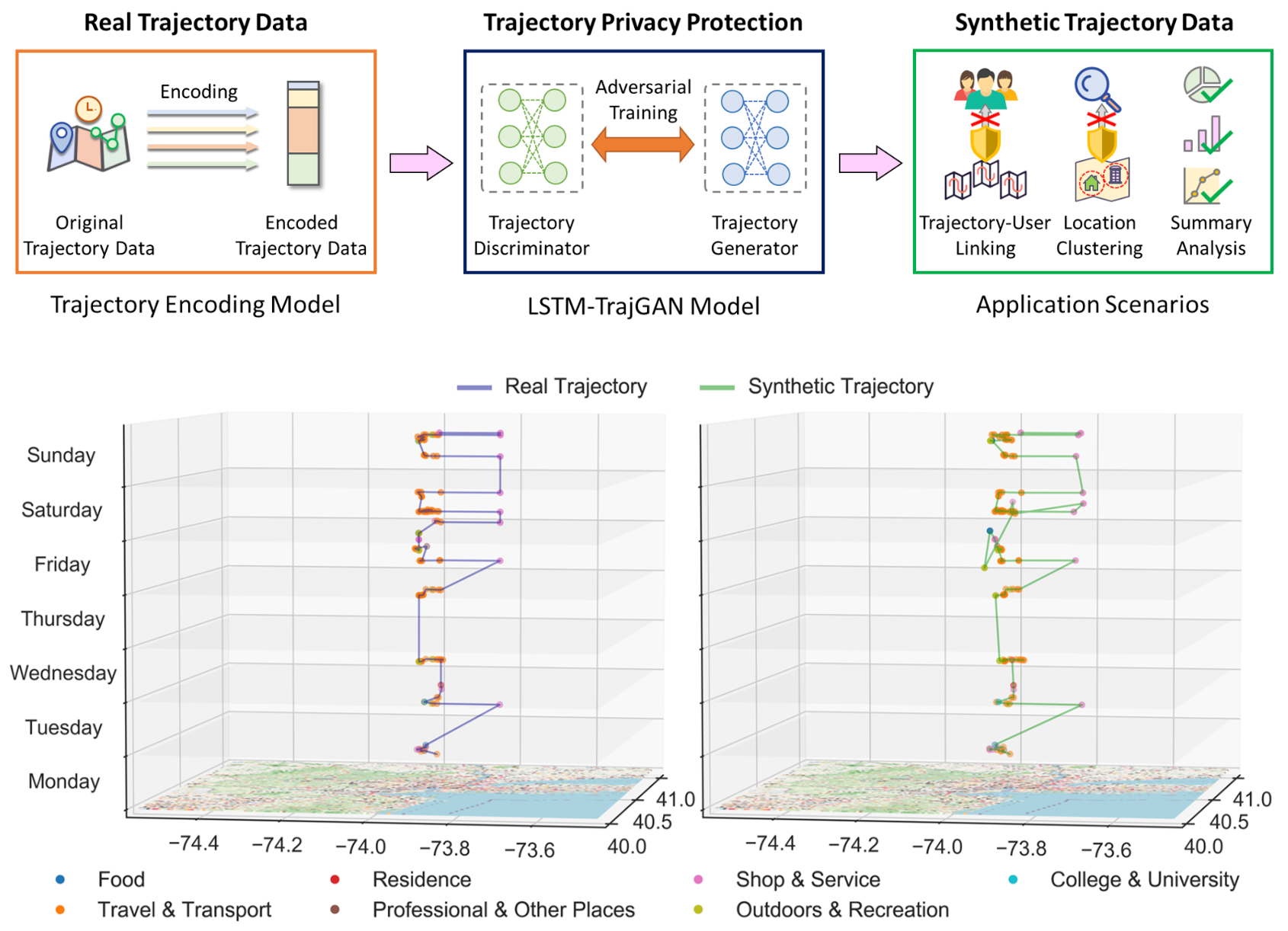
Geoprivacy: responsible use of location data (2019–present)
- Proposed LSTM-TrajGAN (GIScience 2021, 270+ citations), a deep generative model for privacy-preserving synthetic trajectories, released as open-source code (80+ stars, 30+ forks).
- Proposed CATS (IJGIS, 2023) for conditional adversarial trajectory synthesis in privacy-preserving data publication. Also developed a decentralized, privacy-preserving framework for location recommendation (Transactions in GIS, 2021) and VTSV, a privacy-preserving vehicle trajectory simulation platform (ACM SIGSPATIAL GeoAI 2021).
- Wrote a vision paper on privacy-preserving and secure GeoAI foundation models (ACM SIGSPATIAL 2023) and a book chapter on trajectory privacy protection approaches (2025).
- Dissertation Trajectory Privacy Protection with Geospatial Artificial Intelligence (2023), which received the 2024 AAG William L. Garrison Award (one recipient every two years).
- Uptake: LSTM-TrajGAN has become a reference model for synthetic trajectory generation. Other groups have extended it (to enforce differential privacy, IEEE Access 2026; for selective partial anonymization, IEEE Access 2023; with Transformer decoders, MLNLP 2022), built it into processing pipelines (IEEE Access 2023; vehicle-trajectory protection, IEEE Internet of Things Journal 2024), and re-implemented it as the state-of-the-art benchmark (PETS 2022 and 2024; Information Systems Research 2023). Industry researchers at Lenovo (FGCS 2024), State Grid (IEEE T-ITS 2022), Rakuten (IEEE BigData 2022), and ByteDance (IJGIS 2025) have drawn on the trajectory privacy work. Details are in the uptake table.
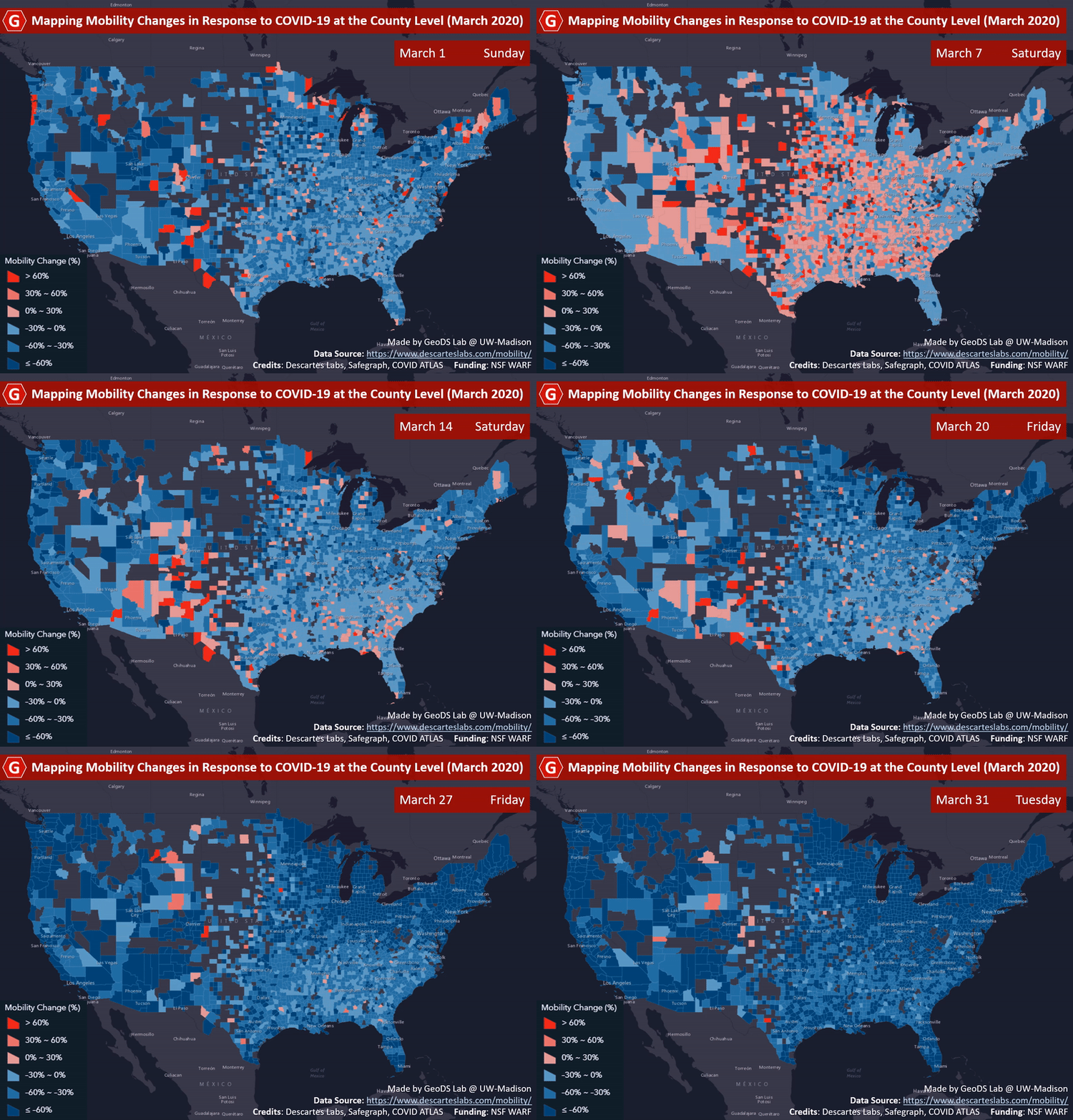
Public health: mobility analytics for COVID-19 response (2020–2021)
- Co-developed one of the first mobility-based social distancing maps and dashboards in the U.S. at the UW–Madison GeoDS Lab (SIGSPATIAL Special, 2020, 410+ citations). The tools used commercial location data (SafeGraph, Descartes Labs) and ArcGIS Dashboards, and were covered by local NBC, ABC, and FOX stations.
- Co-authored a multiscale dynamic human mobility flow dataset (Scientific Data, 380+ citations) and studies linking mobility and infection (JAMA Network Open, 270+ citations; PNAS, 190+ citations).
- This work has been cited in Nature (Chang et al., 2021; Buckee et al., 2021) and PNAS (Thomas et al., 2022). The research was supported in part by the NSF.
- Uptake: the open flow dataset (GitHub, 150+ stars) became a widely used input for mobility and epidemic modeling. For example, the Deep Gravity mobility-flow model co-developed by Amazon researchers (Nature Communications, 2021) was evaluated on it. Industry research teams at Microsoft Research (Nature, 2021), Google (Nature Communications, 2021), Meta, Tencent, Orange, IQVIA, and DiDi (WWW 2026) drew on these results in their own mobility and epidemic studies.
Community building: connecting industry, academia, and students (2019–present)
- Co-founded and directs GISphere (since 2019), a non-profit that helps students worldwide find and apply to GIS graduate programs, supporting the future geospatial workforce. Its survey of prospective GIS students is published in Transactions in GIS, 2023.
- Program Co-chair of the ACM SIGSPATIAL GeoIndustry Workshop for four consecutive editions (2023–2026), a venue built to reduce siloed efforts between geospatial industry and academia (details).
- Demo Track Co-chair of ACM SIGSPATIAL 2026, and organizer of the OASIS 2026 student challenge on open agents with spatial intelligence for social good (co-organized with researchers from Google, Esri, and universities), for which I secured Google DeepMind sponsorship for student participants. Also organizer of the UMFM 2026 workshop on urban mobility foundation models.
- Co-chair of the GeoAI and Deep Learning Symposium at the AAG Annual Meeting (2023–2026) and GeoAI session organizer every year since 2022, including sessions on geoprivacy and ethics in GeoAI (2023).
- Earlier service: Student Director of the AAG GIS Specialty Group (2021–2022), CPGIS committees (2022–2023), and volunteer for UN Mappers and the Wisconsin Land Information Association.
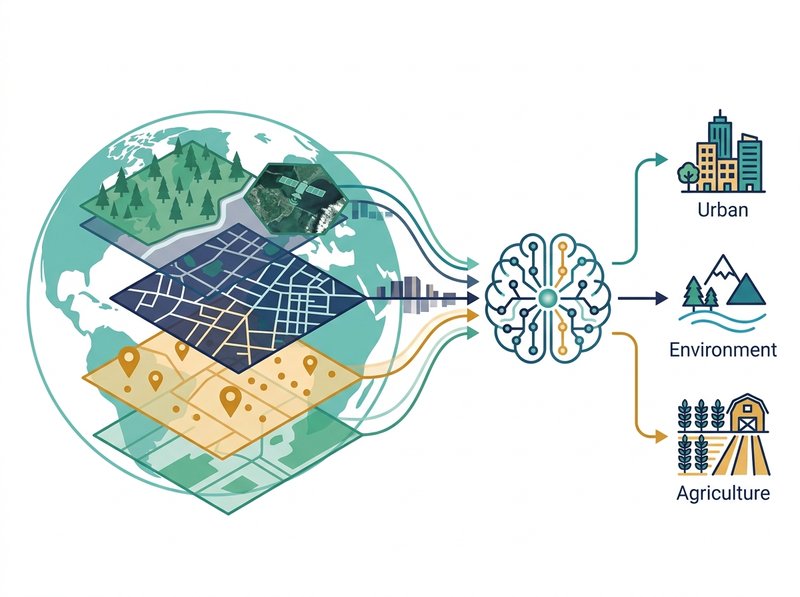
Broader GeoAI research and industry AI work
- GeoAI foundation models: co-authored Towards the Next Generation of Geospatial Artificial Intelligence (JAG, 2025, 220+ citations), drawn on by industry work at Esri (ISPRS J. Photogramm. Remote Sens., 2026), InferLink (KDD 2026), and Meituan (IJGIS, 2025); co-developed SRL (ACM SIGSPATIAL 2024) and TRAJGANR (arXiv, 2026).
- Agriculture and Earth observation (Mineral, Alphabet): multimodal LLMs and retrieval-augmented generation, including IM-RAG (SIGIR 2024); co-inventor of U.S. Patent 12,462,551 and two published U.S. patent applications on multimodal agricultural inference.
- Transportation: urban multiple route planning with reinforcement learning (IEEE T-ITS, 2021) and road network extraction from taxi GPS trajectories (Handbook of Big Geospatial Data).
- Google DeepMind: works on general AI research and geospatial reasoning research, and is a core contributor to Gemini 2.5, Gemini 3, and Gemini 4 Argon (post-training and evaluation).
2Impact on the geospatial industry
Why this work matters to the geospatial industry
- Geoprivacy for the location-data industry. Companies that collect or analyze location data (mobile apps, mobility platforms, connected vehicles) need to share and analyze trajectories without exposing individuals. LSTM-TrajGAN and CATS generate synthetic trajectories that keep the useful patterns of real data while protecting privacy. Industry researchers have drawn on this work in vehicle-network privacy (State Grid, IEEE T-ITS 2022), trajectory privacy models (Lenovo, FGCS 2024), and trajectory-user linking (Rakuten, IEEE BigData 2022).
- Commercial location data for public health. The COVID-19 maps and datasets turned commercial mobility data (SafeGraph, Descartes Labs) into open information through Esri ArcGIS Dashboards, used by the public, local media, and public health researchers. The open flow dataset became a benchmark for mobility models, including the Deep Gravity model co-developed by Amazon researchers, and the work is drawn on by researchers at Microsoft Research, Google, Meta, Tencent, Orange, IQVIA, and DiDi.
- Community that links industry and academia. GeoIndustry, the SIGSPATIAL 2026 demo track, and the OASIS challenge (co-organized with Google and Esri researchers) give industry and academic teams shared venues, while GISphere helps students worldwide enter GIS graduate programs and the geospatial workforce.
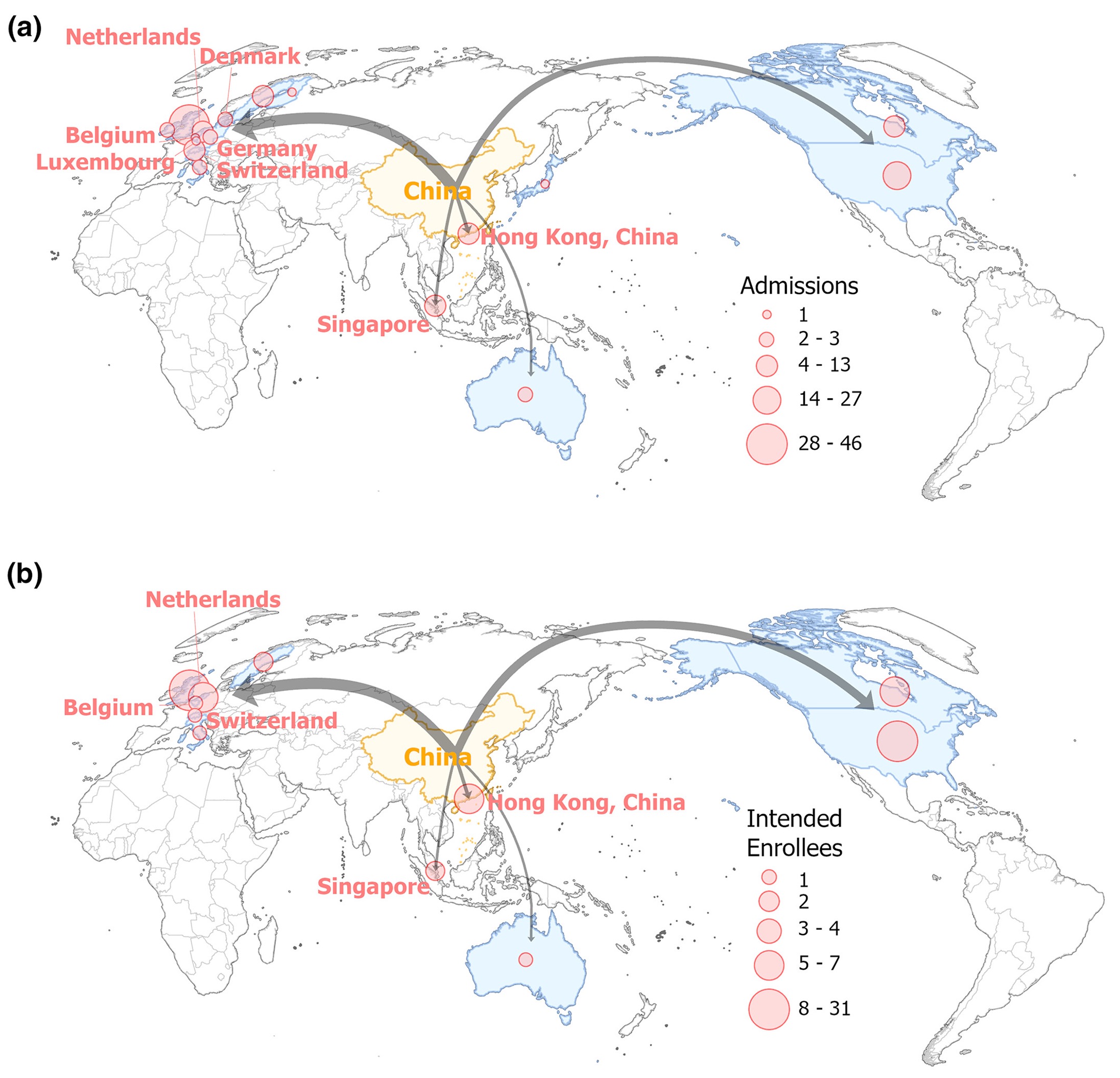
Global reach of the research
The map covers my geospatial and AI research, excluding large team technical reports such as Gemini. It shows where the authors of the 1,600+ distinct publications citing this work are based: 81 countries in total. Each citing publication is counted once, even if it cites several of my papers. Hover over a country to see its count.
Connecting industry and academia through GeoIndustry (2023–2026)
I have served as a Program Co-chair of the ACM SIGSPATIAL International Workshop on Spatial Big Data and AI for Industrial Applications (GeoIndustry) for four consecutive editions, from the 2nd edition (Hamburg, 2023) to the 5th (Riverside, 2026). The workshop's stated goal is to reduce siloed efforts between industry and academia. Industry brings geospatial data and problems at scale, and academia brings new methods. The workshop gives both sides a recurring venue to exchange ideas through invited and regular talks.
- The program chairs and committee include researchers from Amazon, Google, Google DeepMind, Oracle, and PAII, together with faculty from the University of Wisconsin–Madison, the University of Maryland, UT Austin, Florida State University, and the University of Georgia.
- Workshop papers are published by ACM in the GeoIndustry proceedings.
- Editions: 2023 · 2024 · 2025 · 2026
Other industry–academia events at ACM SIGSPATIAL 2026
- Demo Track Co-chair, ACM SIGSPATIAL 2026. The demo track is where academic and industry teams present working geospatial systems (organizing committee).
- Organizer, OASIS 2026. This is the first ACM SIGSPATIAL student challenge on open agents with spatial intelligence for social good. It is co-organized by researchers from Google, Esri, and several universities. I secured Google DeepMind sponsorship to support student participants.
- Organizer, UMFM 2026. A workshop on urban mobility foundation models.
How others have extended, adopted, and used the work
Beyond citation, other research groups have built new methods on my work, adopted it as the benchmark to beat, and used the released data and code in their own systems and studies. Semantic Scholar classifies 22 citations of LSTM-TrajGAN by other authors as “highly influential”, meaning the citing paper relies substantially on it. Selected examples:
| Type | Example (venue, year) | Builds on |
|---|---|---|
| Extended | Rubio-Jornet, Parra-Arnau & Forné adapt LSTM-TrajGAN to enforce differential privacy through gradient perturbation (IEEE Access, 2026) | LSTM-TrajGAN |
| Extended | Song et al. (Korea) develop an exceptional conditional GAN for selective partial anonymization of trajectories, using LSTM-TrajGAN as the base model (IEEE Access, 2023), followed by an attention-based variant (ICOIN 2024) | LSTM-TrajGAN |
| Extended | Cao et al. propose a Transformer-decoder GAN that draws on the model structure and TrajLoss function of LSTM-TrajGAN (MLNLP 2022) | LSTM-TrajGAN |
| Adopted in systems | Fontana, Langheinrich & Gjoreski (USI Lugano) build a unified privacy-aware mobility-modeling pipeline around LSTM-TrajGAN (IEEE Access, 2023); Fan et al. use LSTM-TrajGAN in a two-layer mechanism for protecting vehicle trajectory data (IEEE Internet of Things Journal, 2024); Musleh et al. use it to enrich trajectory datasets (ACM SIGSPATIAL 2022) | LSTM-TrajGAN |
| State-of-the-art benchmark | Re-implemented and used as the reference model in privacy-enhancing-technology research: Zhan, Haddadi & Mashhadi (PETS 2022); Buchholz et al., UNSW and CSIRO's Data61, which calls it “a widely recognised work” (PETS 2024); and consumer mobile-data privacy research in a leading business journal, Macha et al. (Information Systems Research, 2023) | LSTM-TrajGAN |
| Used as data | The open flow dataset is used as a primary data source in studies of flood resilience of transport networks (Nature Sustainability, 2025), biases in mobility data (Communications Physics, 2024), carbon emissions (The Innovation, 2026), origin–destination flow generation (IJCAI 2026), COVID-19 policy impact (WWW 2022), and intercity connectivity and innovation (CEUS, 2024) | Mobility flow dataset (Scientific Data) |
| Used as a benchmark dataset | The Deep Gravity mobility-flow model, co-developed by Amazon researchers, is evaluated on the US flow dataset (Nature Communications, 2021; see also ACM Computing Surveys) | Mobility flow dataset (Scientific Data) |
| Open-source reuse | Public code and data on GitHub: COVID19USFlows (150+ stars, 25+ forks), LSTM-TrajGAN (80+ stars, 30+ forks), CATS | Released code and data |
Sources: Semantic Scholar citation contexts and GitHub, October 2026. Descriptions follow the citing papers' own wording.
Industry research drawing on the work
Based on OpenAlex affiliation data (October 2026, self-citations excluded), about 60 publications co-authored by researchers at 34 companies across the United States, Europe, and Asia cite my geospatial research. Each example below links to the industry paper and to the specific work of mine that it cites. Where the citation context is available (Semantic Scholar), it is summarized or quoted.
| Company | Industry work (venue, year) | Cites | How the work is used or referenced |
|---|---|---|---|
| Amazon | A Deep Gravity model for mobility flows generation (Nature Communications, 2021); A survey on deep learning for human mobility (ACM Computing Surveys) | Scientific Data 2020 | The Deep Gravity model is evaluated on the US flow dataset. The survey describes it as “a dataset of flows aggregated from individual trajectories in the US” used to evaluate flow generators. |
| Microsoft Research | Mobility network models of COVID-19 explain inequities and inform reopening (Nature, 2021) | SIGSPATIAL Special 2020 | Cited in support of using SafeGraph mobility data to model COVID-19 spread. |
| Impacts of social distancing policies on mobility and COVID-19 case growth in the US (Nature Communications, 2021) | JAMA Netw. Open 2020 | Cites the study linking mobile phone mobility data, stay-at-home mandates, and COVID-19 infection rates. | |
| Meta | Large-scale measurement of aggregate human colocation patterns for epidemiological modeling (Epidemics, 2023) | SIGSPATIAL Special 2020 | Cited (methodology) as an example of mobility data used “to measure the causal impact of mobility-oriented interventions”. |
| Esri | A research agenda for GIScience in a time of disruptions (IJGIS, 2024) | JAMA Netw. Open 2020; Scientific Data 2020 | Cited as examples of GIScience responses to COVID-19, including tracking stay-at-home orders “using GPS data from mobile phones”. |
| Esri | Measuring the spatial explicitness of GeoAI and geospatial foundation models (ISPRS J. Photogramm. Remote Sens., 2026) | JAG 2025 | Cited in a systematic review of GeoAI and geospatial foundation models. |
| Tencent | Integrated vaccination and physical distancing interventions to prevent future COVID-19 waves in Chinese cities (Nature Human Behaviour, 2021) | JAMA Netw. Open 2020 | Cites the study linking mobile phone mobility data, stay-at-home mandates, and COVID-19 infection rates. |
| Orange | Mobility during the COVID-19 lockdown in France (Lancet Digital Health, 2020) | SIGSPATIAL Special 2020 | Cites the county-level mobility analysis of the United States. |
| IQVIA | Evidence-driven spatiotemporal COVID-19 hospitalization prediction with Ising dynamics (Nature Communications, 2023) | Scientific Data 2020 | Cites the US mobility flow dataset. |
| DiDi | Enhancing ride-hailing forecasting at DiDi with multi-view geospatial representation learning from the web (WWW 2026) | SIGSPATIAL Special 2020 | Cites the county-level mobility analysis. |
| State Grid Corp. of China | ATPS: an AI-based trust-aware and privacy-preserving system for vehicle managements (IEEE T-ITS, 2022) | LSTM-TrajGAN | Cited (methodology): “motivated by [LSTM-TrajGAN], ATPS system designs a [trajectory privacy protection] scheme using WGAN”. |
| Lenovo | Trajectory privacy preservation model based on LSTM-DCGAN (Future Generation Computer Systems, 2024) | LSTM-TrajGAN; CATS | A GAN-based trajectory privacy model in the same line of work; cites both models. |
| Rakuten | Trajectory-user linking is easier than you think (IEEE BigData 2022); Pre-trained transformer uncovers meaningful patterns in human mobility data (IEEE BigData 2024) | LSTM-TrajGAN; PS-GeoAI FM 2023 | The 2024 paper cites the vision paper as part of “an emergent effort within the GeoAI community aimed at developing Geo Foundation Models”. |
| InferLink | LineLM: an operational language model for large-scale geospatial vector data (KDD 2026) | JAG 2025 | Cites the next-generation GeoAI agenda. |
| Meituan | GLoRA: a parameter-efficient fine-tuning framework for GIS large language models (IJGIS, 2025) | JAG 2025 | Cites the next-generation GeoAI agenda. |
| ByteDance | GeoFM: how will geo-foundation models reshape spatial data science and GeoAI? (IJGIS, 2025) | CATS | Cited as an example of GeoAI applications in transportation. |
Other companies in the data include Baidu, Alibaba, Nokia, Canon, Ipsos, Merck, Nommon, LocationMind, IBI Group, and Tenaga Nasional Berhad.
Engagement with geospatial practitioners
- Presented Mapping Mobility Changes During COVID-19 Using ArcGIS Dashboards and Mobile Experience Builder at the Esri Education sessions, AAG 2023. Also had an extended abstract on federated learning for location data accepted at the Esri User Conference (2020).
Media coverage
- The UW–Madison COVID-19 social distancing maps and dashboards, which I co-developed, were featured by local television news: NBC15, WISN 12 (ABC), and FOX47.
- The dashboard was hosted publicly by the UW–Madison Department of Geography for use by the public, media, and public-health researchers.
3Aspiration
My goal is to help the geospatial industry use location data and AI in ways that are useful, responsible, and open. Over the next several years, I hope to:
- Make privacy protection a standard part of geospatial AI. Methods for protecting location data should be practical enough for location-data providers and mobility platforms to adopt by default, and should extend to geospatial foundation models and AI agents.
- Apply location data and spatial reasoning to public health and social good. This includes my geospatial reasoning research at Google DeepMind and benchmarks and challenges, such as OASIS, that test whether AI models and agents can reason reliably about places, movement, and environmental change.
- Keep building the community. Continue GeoIndustry and SIGSPATIAL venues where industry and academia work on shared problems, and continue supporting students entering the geospatial field through GISphere.
Recognition
- 2024William L. Garrison Award for Best Dissertation in Computational Geography, American Association of Geographers (AAG); awarded to one recipient every two years
- 2024Spotlight Paper, AAAI 2024 Workshop on Responsible Language Models
- 2022SRGC Conference Presentation Award; Trewartha/Odebolt Conference Travel Award, University of Wisconsin–Madison
- 2019Best Poster Paper, ACM SIGSPATIAL RAAS Workshop
- 2015, 2017National Scholarship, Ministry of Education, China
Service to the geospatial community
| Role | Venue | Years |
|---|---|---|
| Demo Track Co-chair | ACM SIGSPATIAL 2026 | 2026 |
| Organizer | OASIS 2026 Student Challenge, ACM SIGSPATIAL (secured Google DeepMind sponsorship for student participants) | 2026 |
| Organizer | UMFM 2026 Workshop (Urban Mobility Foundation Models), ACM SIGSPATIAL | 2026 |
| Program Co-chair | GeoIndustry Workshop, ACM SIGSPATIAL | 2023–2026 |
| Session Chair | ACM SIGSPATIAL main conference | 2024, 2025 |
| Program Committee | ACM SIGSPATIAL GeoAI Workshop | 2023 |
| Symposium Co-chair | GeoAI and Deep Learning Symposium, AAG Annual Meeting | 2023–2026 |
| Session Organizer | AAG Annual Meeting (GeoAI sessions) | 2022–2026 |
| Symposium Chair | GeoAI for Social Sensing, AAG Annual Meeting | 2022 |
| Session Organizer | Geoprivacy and Ethics in GeoAI, AAG Annual Meeting | 2023 |
| Student Director | AAG GIS Specialty Group (GISS) | 2021–2022 |
| Committee Member | CPGIS Career Development Committee and Media Committee | 2022–2023 |
| Committee Member | Curriculum Committee (2020–2021) and Graduate Study Committee (2021–2022), Department of Geography, UW–Madison | 2020–2022 |
| Co-founder & Director | GISphere (non-profit for GIS education) | 2019–present |
| Volunteer | UN Mappers Project; Wisconsin Land Information Association (WLIA); International Conference on Geoinformatics; National Academic Conference on Cartography and GIS (China); ERASMUS+ GeoServices-4-Sustainability | 2018–2022 |
| Reviewer | ACM SIGSPATIAL, NeurIPS, ICLR, ICML, AAAI, ACL, COLM; 30+ journals including IJGIS and Transactions in GIS | since 2020 |
Selected invited talks
- 2023Mapping Mobility Changes During COVID-19 Using ArcGIS Dashboards and Mobile Experience Builder, Esri Education sessions, AAG Annual Meeting
- 2023Privacy and Security Issues in Large-Language-Model-powered Geospatial Applications, Geography According to ChatGPT, University of California, Santa Barbara
- 2023Privacy-Preserving Location Recommendation via Decentralized Collaborative Learning, Built Environment Talk Series, Texas A&M University
- 2023Deep Reinforcement Learning for Driving Trajectory Simulation, Reinforcement Learning Seminar, Anhui University
- 2023Geographic Visualization and ArcGIS Dashboards, Geovisualization and Spatial Analysis Seminar, University of Arkansas
- 2022Trajectory Privacy Protection with Geospatial Artificial Intelligence, UW Roundtable on the Frontiers of Geospatial Artificial Intelligence, University of Washington
Supporting links
Thank you for your time and consideration. — Jinmeng Rao (jinmengrao@gmail.com)